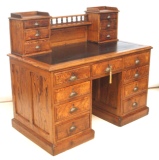
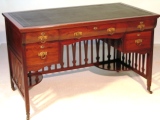
|
Antiquedesks.net
Tel: +44 (0)1460 234731
Fax: +44 (0)1460 234731
Mobile: +44 (0)7834 422358
Home
About Us
How To Find Us
Stock List
Stock
Notes
Payment & Delivery
Comments & Enquiries
Web Links
Site Information
|
Stock Information
All our antique desks are of good quality, are in showroom condition and require no
restoration. They are all genuine antique pieces of functional furniture,
usually supplied with working locks and keys. We do not stock modern reproduction desks.
The focus is on flat top writing furniture such as partners' desks, pedestal
desks, writing tables and occasionally, knee-hole desks. To this selection we
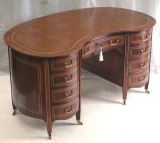
have added interesting pieces such as Dickens desks, roll-tops (tambour and
cylinder types), davenports and kidney shaped desks.
Size
For your convenience, our complete range of desks has been divided into categories and may be
searched by size.
Desks measuring less than 50" in width (127cm)
have been categorised as small.
Medium sized desks are those measuring between
51" (130cm) and 65" (165cm) in width.
Finally, desks measuring 66" (168cm) or more in
width have been categorised as large.
Types of Desks:
- Davenport: A compact form of desk or
writing table which was developed in the late 18th and early 19th
centuries. Regency versions were box-like in appearance with a hinged lid
above a case of drawers, but during the mid 19th century, versions with "piano
tops" were made, with a recessed slide-out writing surface. These davenports
often had hidden catches to release a rising compartment fitted with
stationery drawers.
- Knee-hole: Often made all in one
piece, the knee-hole section between the left and right hand arrangement of
drawers being either open or enclosed, sometimes with a cupboard door.
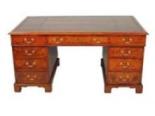
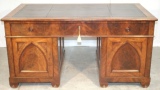
- Partners': A desk originally
designed for two people to use, with cupboards and / or drawers on both of the
longer sides. The partners' desk usually comes in three sections, with two pedestals,
each containing drawers or cupboards which
support a flat top, which is normally inset with a leather writing surface.
The top itself often has three drawers in the front frieze (the horizontal section
beneath the desk top which links the pedestals together), and two drawers at the same
width as the pedestals, which flank a larger central drawer. This
arrangement is usually matched in the frieze at the rear of the partners'
desk. These desks are often placed in a free-standing position in a room, as
they look impressive from all angles, whether viewed from the front or the
rear.
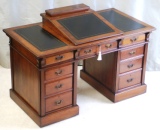
- Pedestal: The pedestal desk also usually comes in three sections, with two pedestals,
each containing drawers or cupboards which
support a flat top, which is normally inset with a leather writing surface.
The top itself often has three drawers in the frieze (the horizontal section
beneath the desk top which links the pedestals together), and two drawers at the same
width as the pedestals, which flank a larger central drawer. Pedestal desks
are often purchased to be placed against a wall, or in an alcove or recess.
- Semi-partners': Similar to the
partners' desk description above, but with false drawers to the rear.
Cupboards to the rear may be false or fully functional.
- Roll-top: Usually a four piece desk
consisting of two pedestals containing drawers, a rear panel and a either a
cylinder top or sliding tambour. The top opens to reveal a flat writing
surface, stationery compartments and drawers.
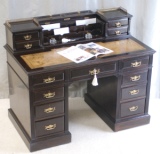
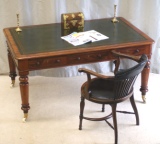
- Writing table: These usually have
one, two or even three drawers in the frieze and can have either solid wooden tops or inset
leather writing surfaces. Edwardian pieces often have a superstructure to
the top, containing additional drawers, stationery compartments, inkwells and
so on.
Wood: The vast majority of our stock is
in mahogany, oak or walnut. There is a great deal of variation in the appearance
of each desk, not only due to the type and cut of the wood used, but also in the
patina built up on the piece over many years.
- Mahogany: The earliest extensive use
of mahogany dates from 1720, with the importation of 'Spanish' or 'Cuban'
timber from Puerto Rico, San Domingo, Jamaica and Cuba. Baywood or
'Honduras' mahogany was used in later years and is lighter in colour and is
generally less well figured.
- Oak: The wood used from the 18th
century onwards is lighter than that of earlier years, with distinctive
tight grain and 'medullary' rays easing the process of identification. In
the best of desks, oak was often used to line drawers.
- Walnut: In the solid, walnut can
easily be mistaken for mahogany. Walnut was much used in veneers until the
mid-18th century. The most attractive types of veneers are burr, oyster or curl.
Approximate Age: In the absence of any
specific evidence, the age of a desk can only ever be approximate. This is not
least because new styles and fashions were not adopted across the whole country
at the same time, as new ideas were sometimes slow to spread or be accepted.
Modifications and Repairs: Desks marked
with the symbol ** are being offered for sale with modifications,
alterations or repairs. These will be pointed out to customers and appropriately
referred to on sales invoices.
It should be noted that the absence of the **
does not necessarily mean that every part of the desk is entirely original. The
vast majority of antique desks offered for sale by UK dealers will have needed
to have had at least some parts replaced. These could include changes to
handles, leather top, castors, hinges, locks and keys. At Antiquedesks.net we
are committed to ensure that our customers are aware of these points before a
sales transaction is concluded.
It would be very unusual indeed to find an
antique desk in truly original condition in every way, not least because desks,
with their moving parts, were functional pieces of furniture and as such were
often in daily use. Leather tops were often used in conjunction with ink which
was prone to spillage. It can be seen then, that an antique desk without any
damage or replacement parts would be a rare exception to the norm, and that this
degree of rarity is usually fully reflected in the sale price of such a piece.
Wherever it has been necessary to carry out
repairs, modifications or restoration, such work has been carried out by
experienced professionals; with the aim of retaining as many original features
and as much of the patina as possible.
|